Knowledge hub
Aluminium die casting glossary
61 terms used every day in aluminium die casting, from alloy and melt to die, shot, heat treatment and inspection, defined in plain technical language.
A
- Alloy
- Aluminium mixed with silicon, copper, magnesium and other elements to give the castability and properties a part needs.
- As cast (F, M)
- A casting that has not been heat treated. F is the Aluminum Association temper; M is the old British designation.
B
- Biscuit
- The slug of solid metal left in the shot sleeve in front of the plunger after each HPDC shot. It is trimmed off with the runner.
- Blister
- A raised bubble on the surface caused by gas trapped just below the skin expanding when the casting is heated.
C
- Clamping force
- The force that holds the two die halves closed against metal pressure, stated in tonnes or kN. It sets the size of part a machine can make.
- Cold chamber machine
- An HPDC machine where metal is ladled into a separate shot sleeve for each shot. Used for aluminium because molten aluminium attacks a submerged injection system.
- Cold shut
- A visible line where two metal fronts met but did not fuse, usually because the metal or die was too cold or the fill too slow.
- Core
- A die part that forms an internal feature or hole. A moving core is pulled out before ejection.
- Cycle time
- The time for one complete casting cycle: close, inject, solidify, open, eject and spray.
D
- DCTG
- Dimensional casting tolerance grade under ISO 8062-3. Lower numbers mean tighter tolerances.
- Degassing
- Removing dissolved hydrogen from molten aluminium, usually by bubbling nitrogen or argon through a rotating impeller.
- Density index
- A measure of gas porosity potential: the density difference between a sample solidified in air and one solidified under reduced pressure, as a percentage.
- Die
- The steel tool, in two halves, whose cavity gives the casting its shape. Also called a mould or tool.
- Die life
- The number of shots a die makes before it needs major repair or replacement, limited mainly by heat checking and erosion.
- Die release agent
- A water based spray applied to the die between shots to cool the surface and stop the casting sticking.
- Draft angle
- The taper on walls parallel to the die opening that lets the casting release cleanly.
- Dross
- Oxides and other non metallic material that forms on and in molten aluminium. It is skimmed off and controlled with flux.
E
- Ejector pin
- A pin that pushes the solid casting out of the moving die half. It may leave a small round mark.
- Erosion
- Wear of the die surface where fast moving metal strikes it, typically opposite the gate.
F
- Fettling
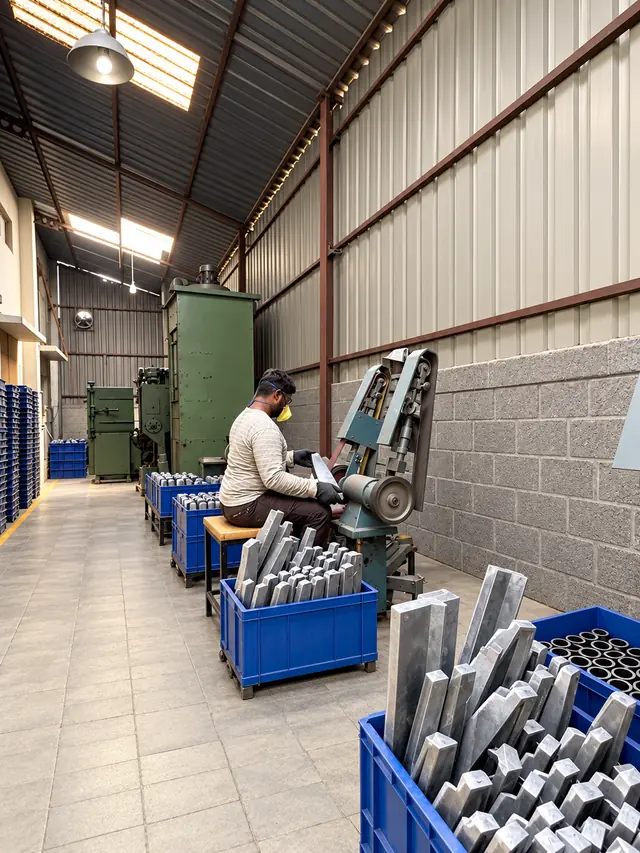
- Removing runners, overflows, flash and parting line material from a casting by hand tools, grinders or trim presses.
- Fill time
- The time to fill the die cavity during the fast shot, typically a few tens of milliseconds in HPDC.
- First article inspection (FAI)
- A full dimensional and material check of the first parts from a new or changed tool before series approval.
- Flash
- Thin fins of metal that escape between die parts at the parting line, slides or ejector pins.
- Flux
- A salt mixture added to molten aluminium to separate oxides into the dross and clean the furnace walls.
G
- Gate
- The narrow opening through which metal enters the die cavity from the runner.
- Gate velocity
- The speed of metal through the gate during the fast shot, typically tens of metres per second in HPDC.
- Grain refinement
- Adding titanium and boron, usually as Al Ti B master alloy, to produce fine, uniform grains, mainly in gravity castings.
- Gravity die casting
- Pouring metal into a reusable steel die under gravity, often with a tilting machine. Also called permanent mould casting.
H
- Heat checking
- A network of fine cracks on the die surface caused by repeated heating and cooling. It leaves a raised pattern on castings.
- High pressure die casting (HPDC)
- Injecting molten metal into a steel die at high speed and pressure, then intensifying the pressure as it solidifies.
- Hot tear
- A crack that forms while the casting is still partly liquid, where shrinkage is restrained by the die or a section change.
I
- Intensification
- The third phase of an HPDC shot: a rapid pressure increase after filling that feeds shrinkage and reduces porosity.
L
- Leak test
- A pressure or vacuum test that proves a casting will hold air or fluid, usually by pressure decay or helium.
M
- Misrun
- A casting that is incomplete because metal solidified before the cavity filled.
- Modification
- Adding strontium or sodium to change the silicon in Al Si alloys from coarse plates to a fine fibrous form, improving ductility.
O
- Overflow
- A small pocket at the end of the fill path that collects cold metal, oxides and air, so they stay out of the casting.
P
- Parting line
- The line on the casting where the two die halves meet.
- Plunger tip
- The end of the plunger that pushes metal through the shot sleeve. It wears and is replaced regularly.
- Porosity
- Voids inside a casting from trapped gas (rounded) or from shrinkage during solidification (irregular).
- PPAP
- Production Part Approval Process: the documents and samples a supplier submits to show a process can make good parts consistently.
- PQ2 diagram
- A chart that matches the machine's injection capability to the die's flow resistance, used to check that a die can be filled at the required gate velocity.
- Projected area
- The area of the casting, runners and overflows seen from the direction of die opening. Multiplied by metal pressure, it gives the opening force.
R
- Reduced pressure test (RPT)
- Solidifying a melt sample under a partial vacuum to reveal hydrogen porosity, used to calculate the density index.
- Runner
- The channel that carries metal from the biscuit or sprue to the gates.
S
- Shot profile
- The recorded plunger speed, position and pressure through each phase of an HPDC shot.
- Shot sleeve
- The steel cylinder into which metal is ladled before the plunger injects it into the die.
- Shrinkage
- The volume reduction as metal solidifies. If it is not fed, it leaves shrinkage porosity, usually in thick sections.
- Slide
- A die part moved by a hydraulic cylinder or angle pin to form an undercut or side feature.
- Sludge
- Hard intermetallic particles of iron, manganese and chromium that settle in a holding furnace when the sludge factor is too high for the temperature.
- Soldering
- Molten aluminium bonding to the die steel, so the casting sticks or tears on ejection.
- Solution treatment
- Heating a casting close to its solidus to dissolve magnesium and copper into solid solution, followed by a quench. The first step of T6.
- Spectrometer
- An instrument that measures the chemical composition of an alloy from a sparked sample in seconds.
- Squeeze pin
- A local pin that pushes into a thick section during solidification to feed shrinkage.
T
- T5
- A casting cooled from the casting process and then artificially aged. Common for HPDC parts that cannot be solution treated.
- T6
- Solution treated, quenched and artificially aged for maximum strength. Called TF in BS 1490.
- T7
- Solution treated, quenched and over aged for better ductility and stability, used for structural castings.
- Trimming
- Removing the runner, biscuit, overflows and flash from an HPDC casting in a trim press.
V
- Vacuum die casting
- HPDC with air drawn out of the cavity before filling, giving lower gas porosity and allowing heat treatment and welding.
- Vacuum impregnation
- Sealing micro porosity by filling it with a resin under vacuum and pressure, so a porous casting becomes pressure tight.
- Venting
- Channels and chill vents that let air escape from the cavity as metal fills it.
W
- Wall thickness
- The section of the casting walls. HPDC suits thin, uniform walls; gravity casting suits thicker sections.
Have a part in mind?Send the drawing and annual volume. An engineer replies within 48 hours.
Request a quote →