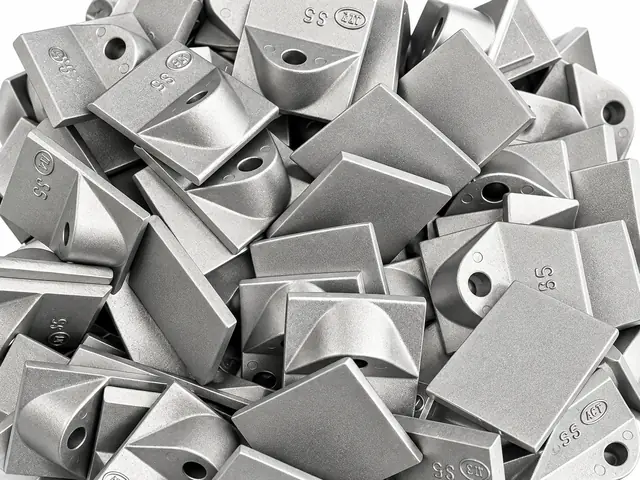
Equivalents: 383, EN AC-46100, LM2 (nearest)
The default HPDC alloy. General housings, covers and brackets.

Materials
Which grade to choose, what is in it, what it is called in other countries and where similar alloys stop being interchangeable. A working reference from the team that melts and casts these alloys every day.
Sourcing and testing
Good castings start with good metal. We buy from leading and specialist alloy producers we have worked with for many years, and we do not take any batch on trust.

Alloy explorer
Filter by process or property. Composition bars show the main alloying elements in weight percent; the dots are a relative guide for comparing grades, not specification values.
12 alloys shown
Equivalents: 383, EN AC-46100, LM2 (nearest)
The default HPDC alloy. General housings, covers and brackets.
Equivalents: A380, EN AC-46500, LM24
Thin wall castings and general components needing strength.
Equivalents: A380, EN AC-46500, ADC10
Industrial housings and gearbox parts. Machines very well.
Equivalents: ADC12, 383 (nearest)
General purpose pressure die castings, covers and housings.
Equivalents: A413, EN AC-44300, ADC1
Thin sections and pressure tight parts.
Equivalents: EN AC-44100, A413 (nearest)
Intricate, thin and water contact parts. Excellent corrosion resistance.
Equivalents: A360, EN AC-43400, ADC3 (HPDC use)
Stressed parts that need corrosion resistance and strength.
Equivalents: EN AC-48000, 336 (nearest)
Low expansion and wear resistance. Pistons and hot running parts.
Equivalents: EN AC-42000, A356 (nearest), AC4C
Structural and safety critical gravity castings, usually heat treated to T6.
Equivalents: EN AC-45000, 319 (nearest)
General engineering castings with moderate strength.
High silicon, low expansion and wear resistant. Used for pistons and wear surfaces. Composition is agreed with you and our alloy partner for each programme.
Customer specific and special alloys can be arranged through our alloy partners, reviewed for process suitability at DFM.
Selection
Start with the process, then the service environment, then machining and finish. Specify the property you need and let us propose the grade.
| If your part needs | Consider | Why |
|---|---|---|
| General housings, covers, brackets by HPDC | ADC12, LM24, A380 | Best balance of castability, strength and machinability at the lowest cost. |
| Thin walls or pressure tightness | LM20, LM6, A413 | Near eutectic silicon gives high fluidity and dense, sound walls. |
| Outdoor, marine or water contact | LM6, LM9, LM25 | Low copper means far better corrosion resistance. |
| Structural or safety critical, heat treated | LM25 (T6) by gravity casting | Low iron and magnesium give strength and ductility after heat treatment. |
| Heat or wear, low thermal expansion | LM13, AlSi132 | Silicon, nickel and copper hold dimensions at temperature and resist wear. |
| Heavy machining, clean threads | LM24, ADC12, LM4 | Copper bearing alloys cut cleanly and hold thread form. |
| Decorative anodising | Talk to us first | High silicon die casting alloys anodise dark and uneven. Powder coating is usually the better route. |
Same alloy, different names
Each region wrote its own standard, so the same family of alloys carries different names. These are the nearest commonly accepted matches, not identical specifications.
| Europe, EN 1706 | USA, AA / ASTM | UK and India, BS 1490 | Japan, JIS | Main process |
|---|---|---|---|---|
| EN AC-46500 AlSi9Cu3(Fe)(Zn) | A380 | LM24 | ADC10 | HPDC |
| EN AC-46100 AlSi11Cu2(Fe) | 383 | LM2 | ADC12 | HPDC |
| EN AC-44300 AlSi12(Fe) | A413 | LM20 | ADC1 | HPDC |
| EN AC-43400 AlSi10Mg(Fe) | A360 | LM9 | ADC3 | HPDC |
| EN AC-44100 AlSi12(b) | A413.0 (nearest) | LM6 | None direct | Gravity and HPDC |
| EN AC-42000 AlSi7Mg | A356 (nearest) | LM25 | AC4C (JIS H 5202) | Gravity |
| EN AC-48000 AlSi12CuNiMg | 336 (nearest) | LM13 | AC8A (JIS H 5202) | Gravity and HPDC |
| EN AC-45000 AlSi6Cu4 | 319 (nearest) | LM4 | AC2B (nearest) | Gravity |
Write the full designation and standard on the drawing, for example “EN AC-46000 to EN 1706” or “A380 to ASTM B85”. Material certificates are then checked against that standard.
Similar, not identical
ADC12 runs higher silicon for fluidity; A380 carries more copper for strength and allows more zinc. Both are general HPDC alloys. Check the copper and zinc limits if the part sees moisture.
LM6 keeps copper, iron and zinc very low for corrosion resistance and gravity casting. LM20 and A413 allow more iron, which helps die release in HPDC but lowers ductility.
A356 holds iron to 0.20% for higher elongation; LM25 allows up to 0.5%. For safety critical parts, specify the low iron grade and the temper, typically T6.
LM24 has more copper and machines beautifully; LM2 runs higher silicon and flows better into thin sections. Both are poor choices for decorative anodising.
Composition reference
Weight percent, summarised from JIS H 5302 and BS 1490 for the grades we cast. Aluminium is the balance. Other elements and limits apply; the current edition of the governing standard and your drawing take precedence.
| Alloy | Process | Si | Cu | Mg | Fe | Zn | Heat treatable |
|---|---|---|---|---|---|---|---|
| ADC12 JIS H 5302 | HPDC | 9.6 to 12 | 1.5 to 3.5 | max 0.3 | max 1.3 | max 1 | No |
| ADC10 JIS H 5302 | HPDC | 7.5 to 9.5 | 2 to 4 | max 0.3 | max 1.3 | max 1 | No |
| LM24 BS 1490 | HPDC | 7.5 to 9.5 | 3 to 4 | max 0.3 | max 1.3 | max 3 | No |
| LM2 BS 1490 | HPDC | 9 to 11.5 | 0.7 to 2.5 | max 0.3 | max 1 | max 2 | No |
| LM20 BS 1490 | HPDC | 10 to 13 | max 0.4 | max 0.2 | max 1 | max 0.2 | No |
| LM6 BS 1490 | HPDC and Gravity | 10 to 13 | max 0.1 | max 0.1 | max 0.6 | max 0.1 | No |
| LM9 BS 1490 | HPDC and Gravity | 10 to 13 | max 0.2 | 0.2 to 0.6 | max 0.6 | max 0.1 | Yes |
| LM13 BS 1490 | HPDC and Gravity | 10 to 12 | 0.7 to 1.5 | 0.8 to 1.5 | max 1 | max 0.5 | Yes |
| LM25 BS 1490 | Gravity | 6.5 to 7.5 | max 0.2 | 0.2 to 0.6 | max 0.5 | max 0.1 | Yes |
| LM4 BS 1490 | Gravity | 4 to 6 | 2 to 4 | max 0.15 | max 0.8 | max 0.5 | Yes |
Special alloys
For demanding parts we can work with our alloy partners on special grades. Each is reviewed for process suitability at the DFM stage before we quote.
AlSi10MnMg family (EN AC-43500). Manganese replaces iron for die release, giving high ductility for structural and crash relevant parts.
A356 type with tight iron limits for maximum elongation after T6 heat treatment.
Aluminium magnesium alloys such as EN AC-51400 for marine and food contact environments, where anodising quality matters.
Tightened limits on copper, zinc or iron to match your global specification or an existing approved part.